
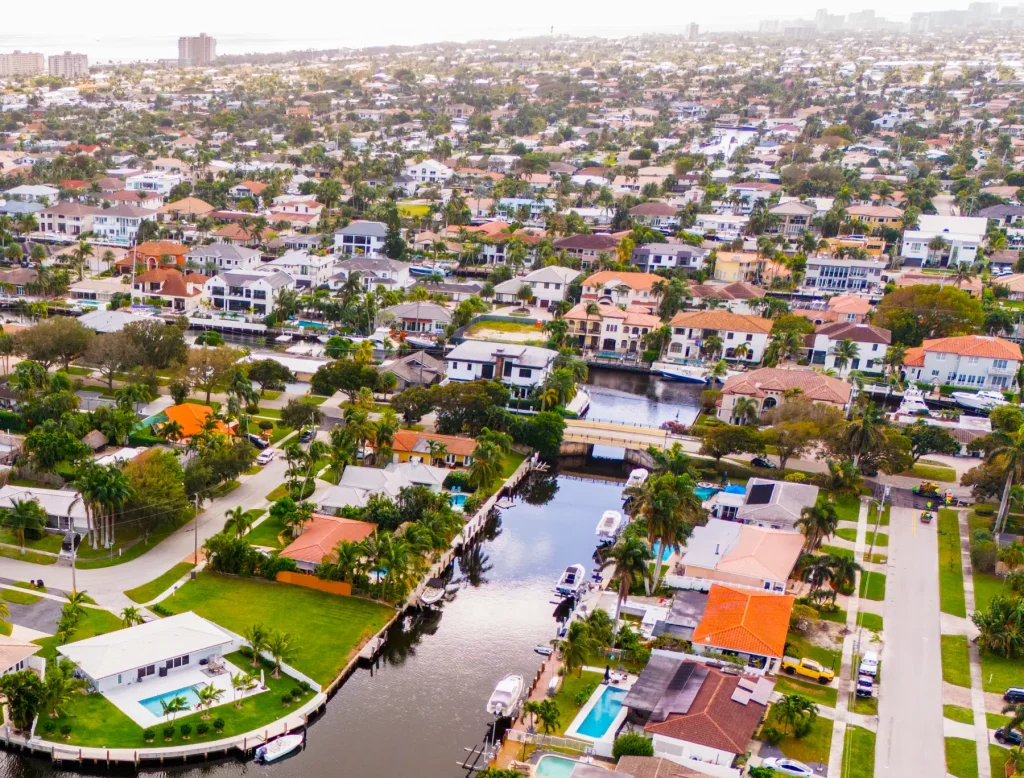
In South Florida’s waterfront market, one detail consistently separates the homes that sell at premium prices from those that don’t — and most buyers and sellers don’t fully appreciate it until they’re deep in a transaction.
Whether a property has unobstructed direct ocean access, or must pass beneath one or more fixed bridges to reach open water, is one of the single strongest factors driving price per square foot. Based on our analysis of current Lighthouse Point waterfront inventory and Deerfield Beach waterfront inventory, the no-fixed-bridge premium runs roughly 20–40% per square foot compared to comparable homes on fixed-bridge canals.
On a 3,000-square-foot home, that translates into a real-dollar difference of $400,000 to $700,000 at closing. It’s not a rounding error. It’s the largest single quantifiable factor in waterfront valuation outside of water type itself.
What “no fixed bridge” actually means
A no-fixed-bridge property has a route from its dock to the Atlantic Ocean — typically via the Hillsboro Inlet — without any permanent overhead obstruction. This means the property can accommodate vessels with significant air draft: sailboats with masts, sport fishing boats with tall towers, yachts with flybridges, and larger center consoles.
By contrast, a fixed-bridge canal home is restricted by the lowest bridge clearance on its route to open water. Even a vessel that fits today may not fit a future upgrade. For buyers who own — or plan to own — meaningful boats, this is a non-negotiable specification.
The buyer pool for a no-fixed-bridge home is fundamentally different from the buyer pool for a fixed-bridge canal. That’s why the price difference is structural, not seasonal.
A real Lighthouse Point reference point
A recent Venetian Isles deepwater estate on Della Torre Canal — 2,773 square feet on 90 feet of no-fixed-bridge waterfrontage — was valued at approximately $2.5 million, working out to roughly $904 per square foot.
By comparison, the broader Lighthouse Point market shows active waterfront inventory averaging around $435 per square foot, with single-family sold comps averaging closer to $799 per square foot. The premium for verified no-fixed-bridge properties with deepwater dockage is clearly visible in the data.
Side-by-side: what the numbers look like
To illustrate the premium, consider two hypothetical Lighthouse Point waterfront homes — identical in size, condition, and finish, but on different canal systems:
- Fixed bridge canal — Typically $650–$750 per square foot. Limited to vessels under approximately 50 feet with low air draft.
- No fixed bridge canal — Typically $850–$1,050 per square foot. Accommodates yachts, sailboats, and larger sport fishing vessels.
Apply those ranges to a 3,000-square-foot home: the fixed-bridge home values at roughly $1.95M to $2.25M. The no-fixed-bridge home values at $2.55M to $3.15M. The midpoint gap is approximately $600,000.
Why the range is wide
Not every no-fixed-bridge home commands the top of the range. Several factors determine where a specific property lands:
- Deepwater dockage. Water depth at mean low tide that accommodates larger vessels without draft concerns drives the highest premiums.
- Wide canal frontage. Ease of maneuvering — particularly for vessels over 60 feet — pushes value up.
- Minutes to the inlet. Properties within 5–10 minutes of the Hillsboro Inlet command top-of-range pricing.
- Modern seawall and dock. Recent construction reduces perceived future cost for buyers.
What this means for sellers
If you own a no-fixed-bridge waterfront home, your listing, photography, drone video, and marketing materials must explicitly call out the no-fixed-bridge access. Many listings bury this detail or omit it entirely — costing sellers meaningful pricing power. When the right buyer sees “no fixed bridge, direct ocean access,” it triggers serious interest. When they don’t see it, your home competes against a much broader and more price-sensitive pool.
If you own a fixed-bridge home, pricing precision matters more than ever. Your comps must be drawn from the same access category — not just the same neighborhood. A fixed-bridge home priced against no-fixed-bridge comps will sit on the market. Priced correctly against its peers, it can still command strong interest, particularly from buyers with smaller vessels who value the neighborhood, the lot, or the home itself over offshore boating access.
What this means for buyers
Match the home to your actual boating plans. If you own a 30-foot center console with a low T-top, a fixed-bridge canal with adequate clearance may deliver excellent value — you’re paying less for access you don’t need. If you own a sailboat, yacht, or plan to upgrade your vessel in the next decade, no-fixed-bridge is essentially non-negotiable and worth the premium.
Either way, before any offer, verify three specifications: the lowest bridge clearance on the route to the inlet, the water depth at mean low tide along that route, and the total time from dock to open water at idle speed. Some listings describe a property as “no fixed bridge” when only portions of the route actually qualify.
The verification step most agents skip
Walking the route — physically — from dock to open water is the step that separates serious waterfront representation from generalist agents pretending to know the market. We document this for every waterfront client. It protects buyers from misleading listings and protects sellers from buyer due diligence surprises that derail closings.
Want the full data and analysis?
Download our complimentary Bridge Premium Special Report — a four-page analysis covering pricing ranges, side-by-side comparisons, and what drives the premium higher. Delivered as a private PDF. No newsletter spam.